
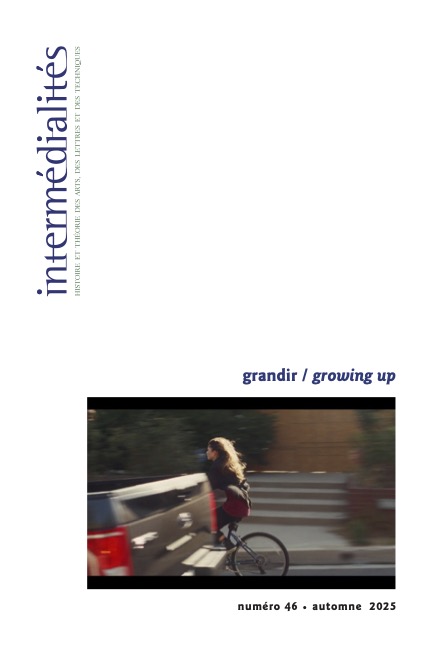
Issue 46, Spring 2026
Guest edited by Marta Boni and Stéfany Boisvert
Change, mutation, chaos, new horizons, encounters with norms, first experiences, moments of identity awareness—growing up unfolds through stages that are at once painful and exhilarating. Childhood and adolescence, marked by definitional ambiguity, are transitional states whose boundaries and representations shift across cultures and historical periods.
This issue of Intermédiality examines how cinema, television, literature, the visual arts, and digital media narrate and give form to this delicate process. Media objects help normalize the transition to adulthood and shape how this stage is understood, fulfilling a triple function: prescriptive, counter-hegemonic, and supportive of our understanding of becoming.
Across literature, cinema, and media more broadly, adolescence has been imagined as a transitional phase defined by negation, change, and opposition. A range of related concepts emerges from this framework: marginal perspectives, minor sensibilities, learning, memory, nostalgia, and relations to community. Media representations also frequently adopt an adultist stance, reproducing relations of domination through a “reassuring” vision of childhood as vulnerable, naïve, asexual, in need of protection, and devoid of dissident agency. At the same time, they offer images of rupture and utopia that open up meaningful alternatives to dominant injunctions.
In turn, childhood and adolescence must be understood as essential conceptual categories for thinking about media. Intermediality is mobilized here as a tool for foregrounding not only aesthetic and formal characteristics, but also the social, communal, and political dimensions of these media encounters. Attending to their multiform materiality and situating media objects within their contexts makes visible networks of relations, borrowings, and layered forms of embeddedness. The link between growing up and intermediality thus becomes clear: the intermedial space in which growing up takes shape accompanies growth itself, transforming alongside it and continually reconfiguring in response to the discourses that give it form.
The nine contributions gathered in this issue make visible some of these meaningful forms, opening a dialogue around a theme of pressing contemporary relevance and significant social and cultural resonance, while remaining open to the unexpected.